AVIATION GAMIFIED

The go/no-go call, the speak-up that breaks the silence, the procedure that holds at 3 a.m. We build those decisions into scenarios crews practice, not slides they click through. Custom for your fleet, your operation, and the authority you answer to.

CRM & TEM Cabin Safety Dangerous Goods Human Factors Ramp Safety De-Icing SMS & Just Culture

The aircraft is the safest part of the system.

Aviation spent a century engineering failure out of the machine, and it worked. What is left is us: the misread checklist, the doubt nobody voiced, the rushed turn, the shipment no one questioned.

Most of it still gets trained with a slide deck and a classroom day, then practiced for real on the line. The judgment that prevents the next event is the one thing those formats can’t teach.

So make it a scenario.

You don’t talk your way to a good go-around or a clean shipment. You practice it. We build custom simulations around the real procedures, aircraft, and regulations your people work inside, so the decisions that matter are rehearsed long before they’re real.

Hours & Checklists Competency & Judgment
Slide Decks & SCORM Decision Practice
Once-a-Year Sim Recurrent Reps

What the research says.

0 Competencies, One Standard ICAO’s CBTA framework folds CRM and threat & error management into nine assessed competencies. They are what ‘trained’ now means. Source: ICAO / IATA CBTA
+0% Better Retention Skills learned through active, game-based practice stick better than the same lesson delivered passively. Source: Bediou et al.
0% Maintenance Is Human Boeing found maintenance a major contributing factor in roughly one in seven accidents. The fix is human factors, not better tools. Source: Boeing / SKYbrary
$0B Training Market by 2044 Airbus sizes aviation training services at this by 2044. The spend is there. The question is whether it builds judgment. Source: Airbus GSF

Simulate the skills that matter.

Three tracks. Every title is built custom around your fleet, your regulator stack, and the events that have actually shaped your operation.

TRACK · A

Flight Deck & CRM

The non-technical competencies a full-flight sim can’t isolate and a slide can’t teach.

  • 01CRM & threat and error management
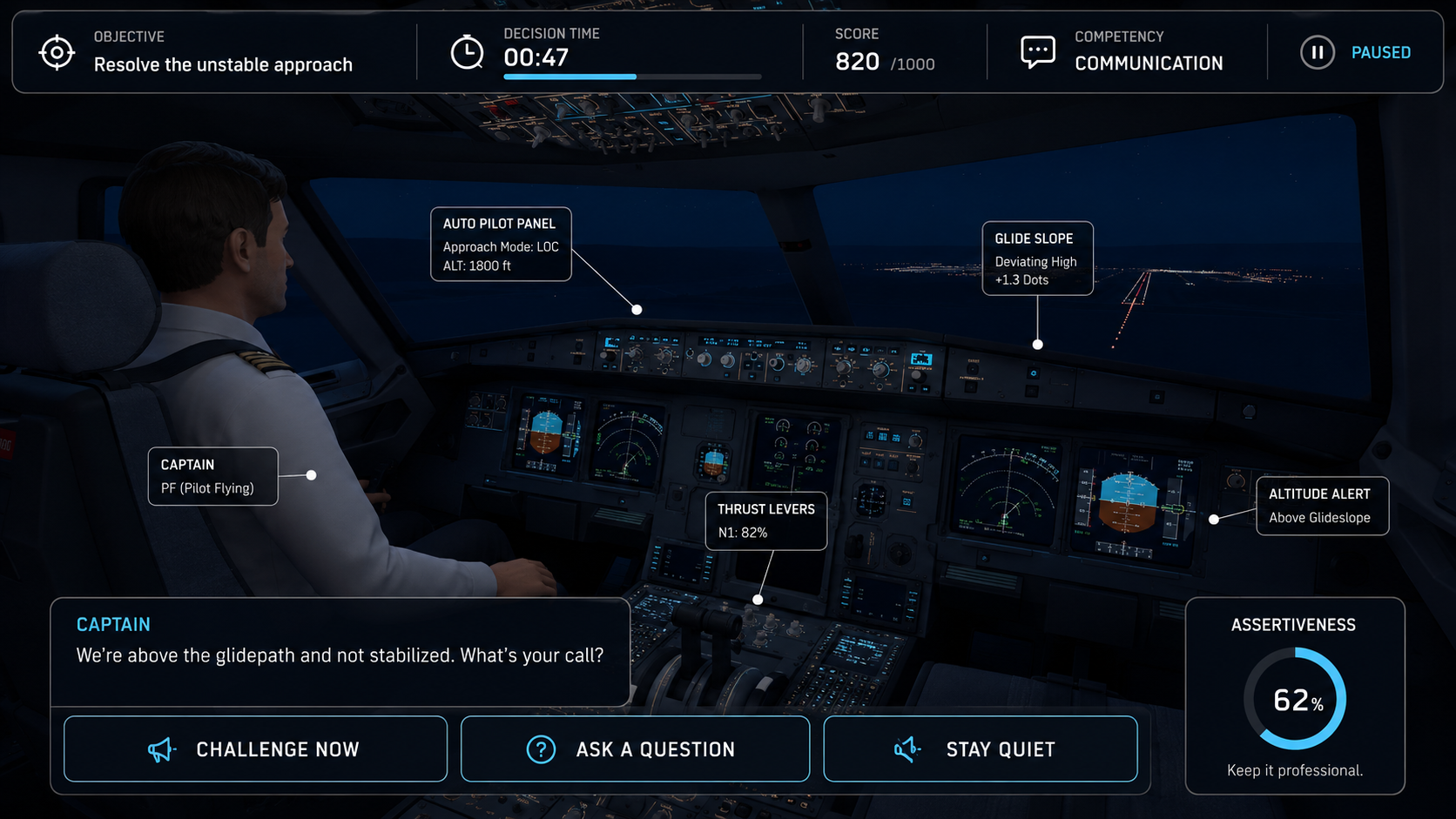
  • 02Authority gradient & speak-up
  • 03Automation & mode awareness
  • 04Manual flying, upset & startle
  • 05Monitoring & cross-check discipline
TRACK · B

Cabin Safety & Emergency

Decision practice for the moments cabin crew train for and almost never rehearse under pressure.

  • 01Evacuation assessment & command
  • 02Fire, smoke & decompression
  • 03Medical & first-response decisions
  • 04Disruptive-passenger de-escalation
  • 05Crew coordination & communication
TRACK · C

Ground, Technical & Compliance

Scenario games for the frontline where most of the cost and most of the risk actually sits.

  • 01Ramp safety & turnaround judgment
  • 02Maintenance human factors & the Dirty Dozen
  • 03Dangerous goods acceptance
  • 04De-icing & winter operations
  • 05SMS reporting & Just Culture

Concepts we can build for you.

We build custom training simulations for aviation. The ten below are concepts we’ve designed to spark ideas. Expand any card to see how it plays, then we build something made for your crews and your fleet.

The Gradient GU-AV-01 CRM

The Gradient

Crew Resource Management Sim

Click to expand ↓

A flight-deck scenario game built around the authority gradient: the moment a first officer sees something wrong and has to decide whether to say it, and how hard to push when the captain doesn’t respond. Players run threats and errors through the nine CBTA competencies, and scoring rewards the challenge that gets heard, not just the technically correct call. The instinct comes from drilling the same standoff a dozen ways. Built on the communication breakdown that destroyed two 747s at Tenerife in 1977, the accident that created CRM.

Use Case
First officers, captains, CRM and EBT facilitators, type-rating recurrent
Key Skills
Communication, assertiveness, threat & error management, workload, decision-making
Ninety Seconds GU-AV-02 Cabin Safety

Ninety Seconds

Time-Pressured Decision Game

Click to expand ↓

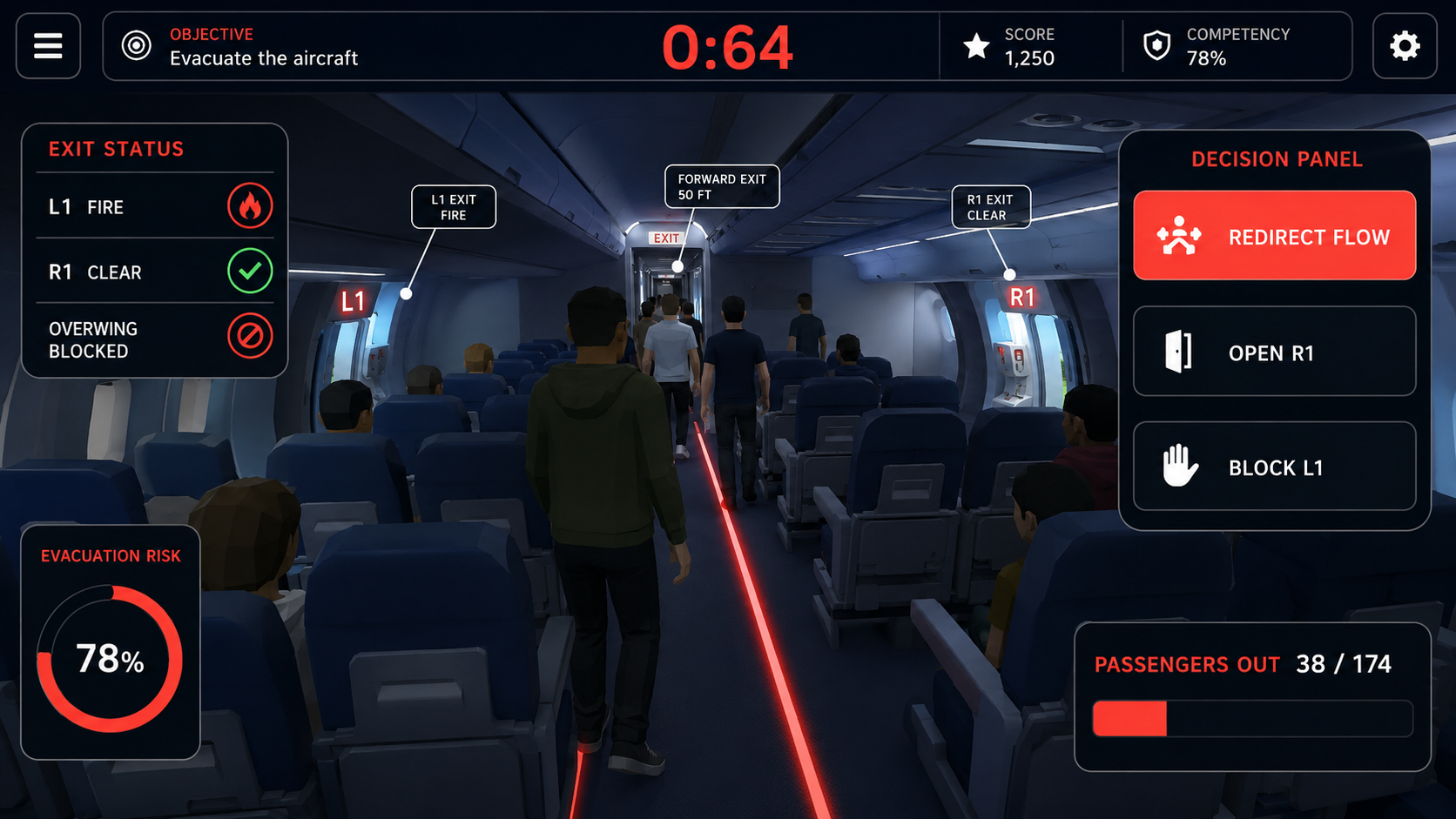
An evacuation-command game that starts where the door drills stop. The aircraft is down, and the senior cabin crew member has seconds to read the conditions: fire on the left, a jammed exit, a blocked aisle, passengers freezing or surging. Players assess, choose usable exits, and command the cabin against the 90-second certification standard, scored on the decisions and the commands, not the muscle memory of the handle. This is the judgment layer the door-and-slide VR rigs were never built to train.

Use Case
Cabin crew, cabin managers, SEP instructors, recurrent safety training
Key Skills
Situational assessment, exit decision-making, command presence, crowd and passenger management
The Acceptance Desk GU-AV-03 Dangerous Goods

The Acceptance Desk

Investigative Document Game

Click to expand ↓

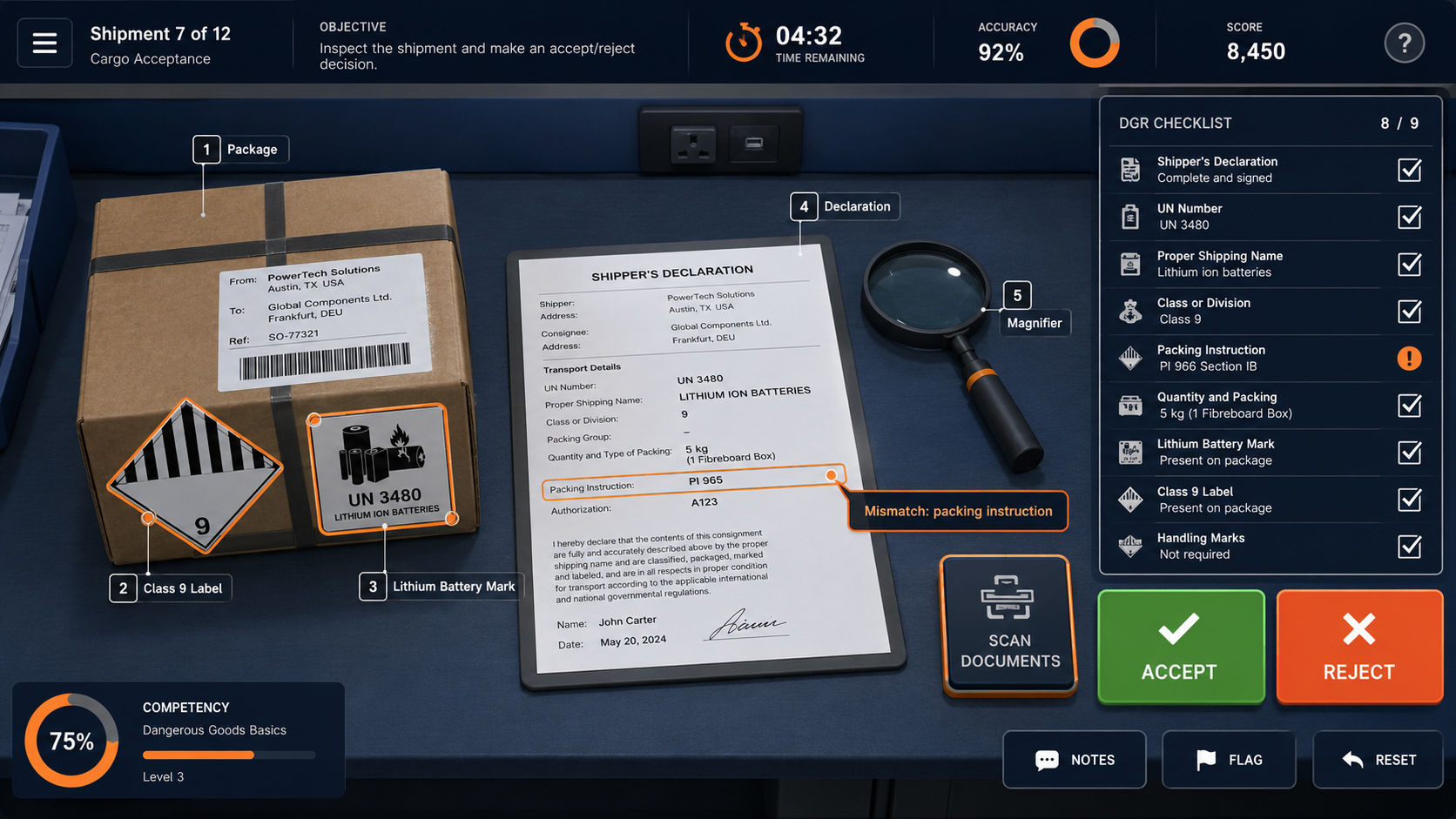
A dangerous-goods acceptance game where the player works the cargo counter, checking shipments and Shipper’s Declarations against the IATA DGR. Hidden and mis-declared goods are seeded at calibrated difficulty: a wrong packing instruction, an undeclared lithium-battery shipment, a class that doesn’t match the paperwork. Accept the wrong box and the consequences play out in the hold. Built around ValuJet 592, where mislabeled oxygen generators brought down a DC-9, and the UPS 6 lithium-battery fire out of Dubai.

Use Case
Cargo and ramp acceptance staff, DG-responsible persons, freighter and ground-handling operators
Key Skills
DGR acceptance checks, lithium-battery rules, declaration verification, accept or reject judgment
The Last Inspection GU-AV-04 Human Factors

The Last Inspection

Procedural Pressure Sim

Click to expand ↓

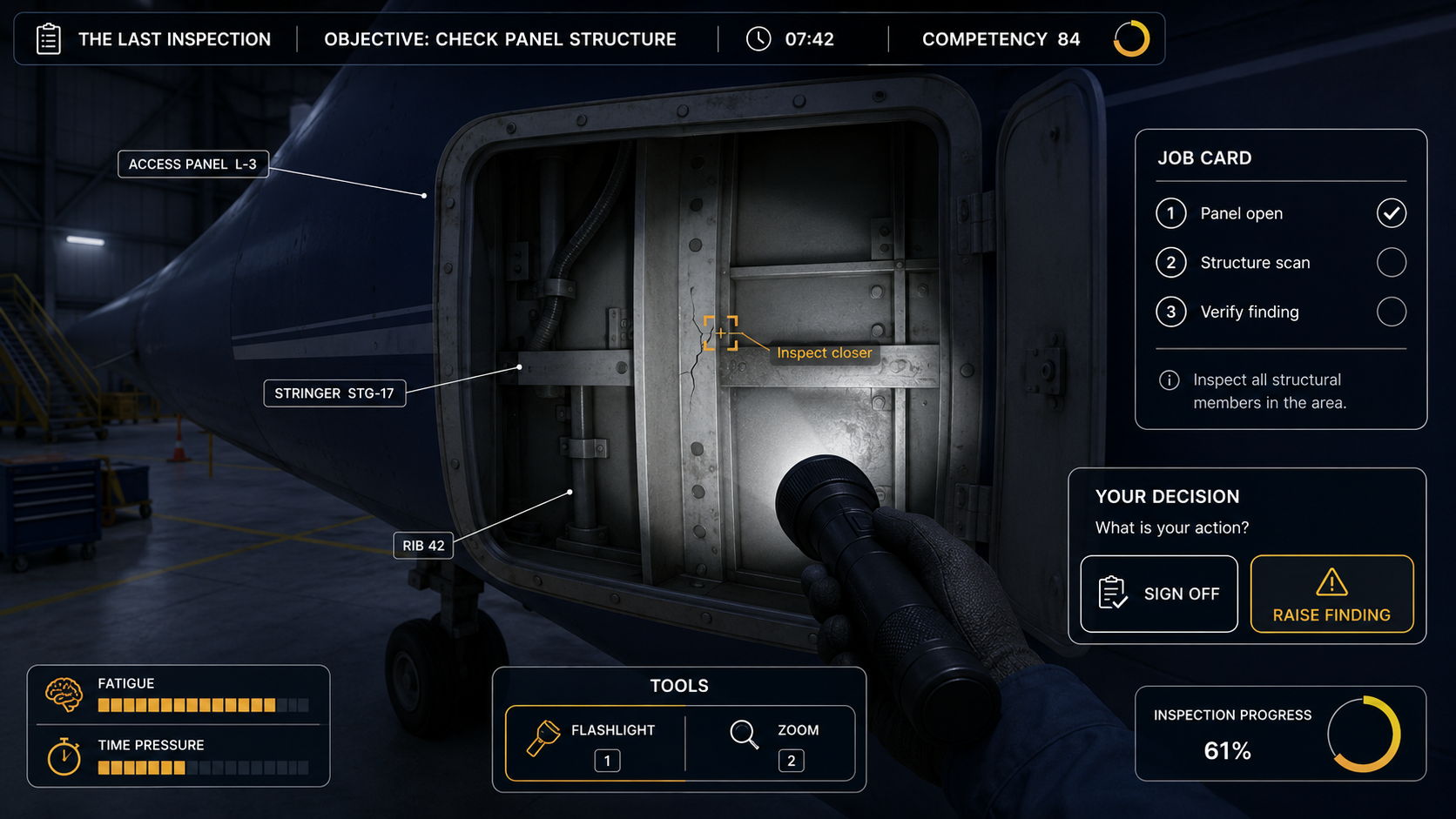
A maintenance human-factors game where the player works a job card on a night shift with the Dirty Dozen pressing in: fatigue, time pressure, a distraction at the wrong moment, the norm of signing off what the last shift always signs off. The trap is built into the task, and the player has to catch it before the sign-off. Built on Aloha 243, where missed fatigue cracking peeled the roof off a 737 in flight, and BA 5390, where the wrong bolts let a windscreen blow out at altitude.

Use Case
Licensed engineers, Part-145 and Part-66 technicians, MRO and Part-147 academies
Key Skills
Dirty Dozen awareness, inspection discipline, error capture, refusing unsafe pressure
Turnaround GU-AV-05 Ramp Safety

Turnaround

Real-Time Coordination Sim

Click to expand ↓

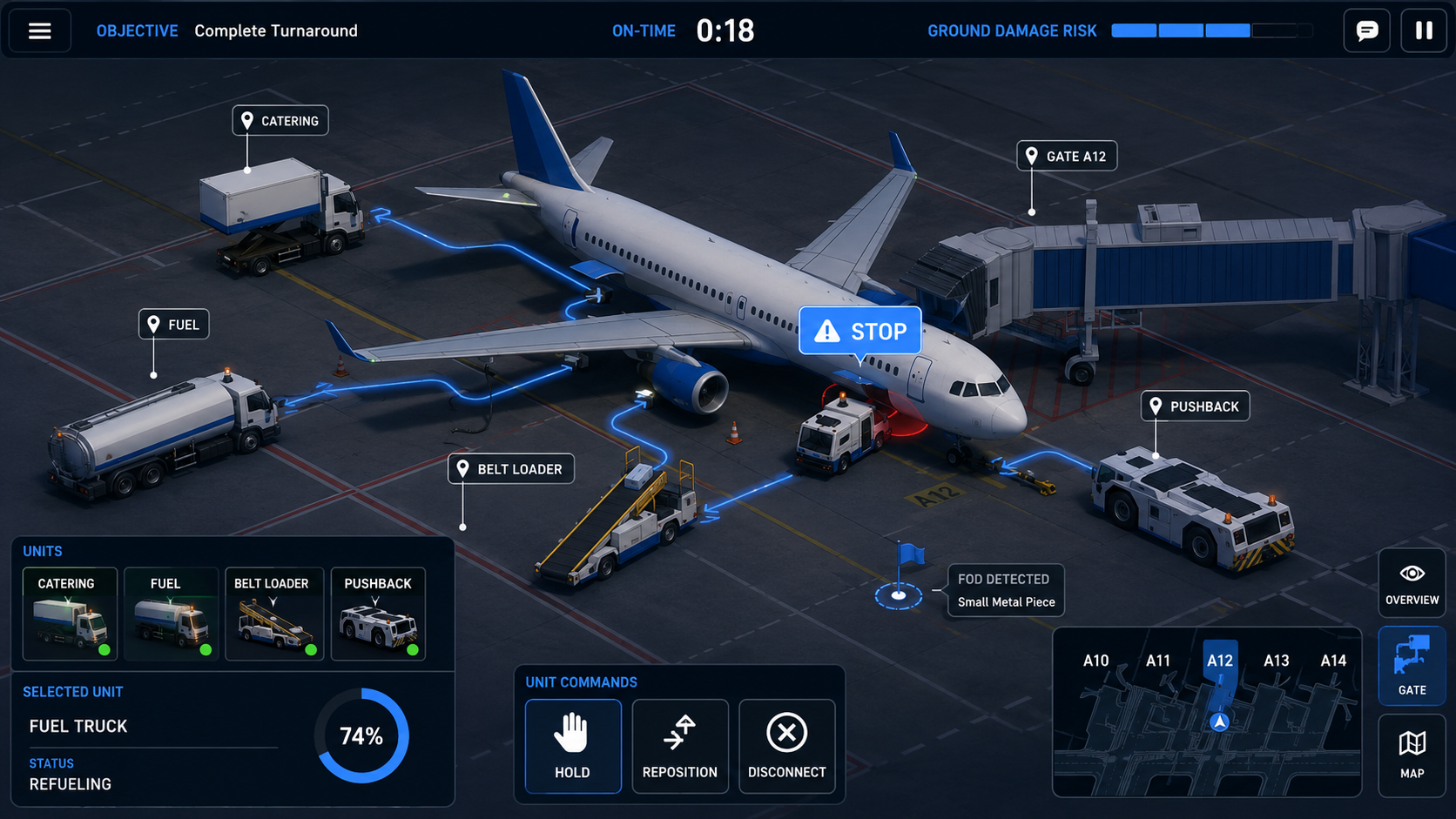
A ramp-coordination game where the player runs a turn against the clock: marshalling, GSE positioning, the pushback, the walk-around, the FOD nobody has time to pick up. Every shortcut that saves a minute raises the odds of the ground damage that costs millions, and the game scores the call to slow down or stop as highly as the on-time departure. This is the decision layer above the equipment, not another lesson in driving the belt loader.

Use Case
Ramp agents, turnaround coordinators, ground-handling supervisors, station managers
Key Skills
Turnaround sequencing, ground-damage avoidance, FOD discipline, stop authority, ramp communication
Holdover GU-AV-06 De-Icing

Holdover

Go / No-Go Decision Game

Click to expand ↓

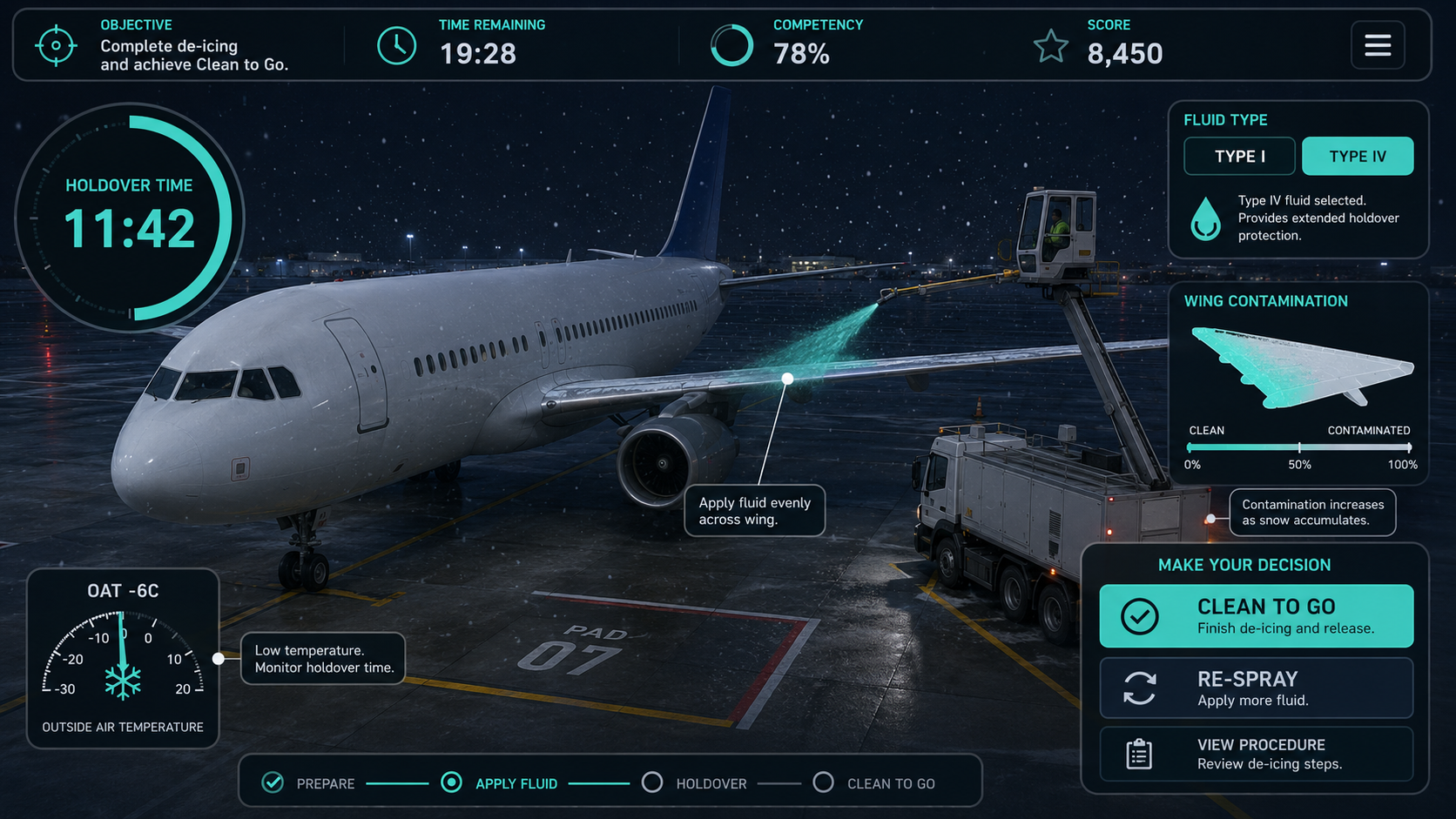
A de-icing decision game played against falling snow and a running clock. The player reads the conditions, chooses fluid type and mix, tracks the holdover time as it burns down, and makes the call: clean to go, or back for another spray. Wait too long and contamination you can’t see from the flight deck changes the wing. Built on Air Florida 90, where snow and a missed crew callout put a 737 into the Potomac, and the 1989 Dryden accident that rewrote how the industry thinks about ground icing.

Use Case
Flight crews, de-icing crews and coordinators, winter-operations and dispatch teams
Key Skills
Holdover-time judgment, contamination recognition, fluid selection, no-go decisions
Children of the Magenta GU-AV-07 Automation

Children of the Magenta

Automation & Startle Sim

Click to expand ↓

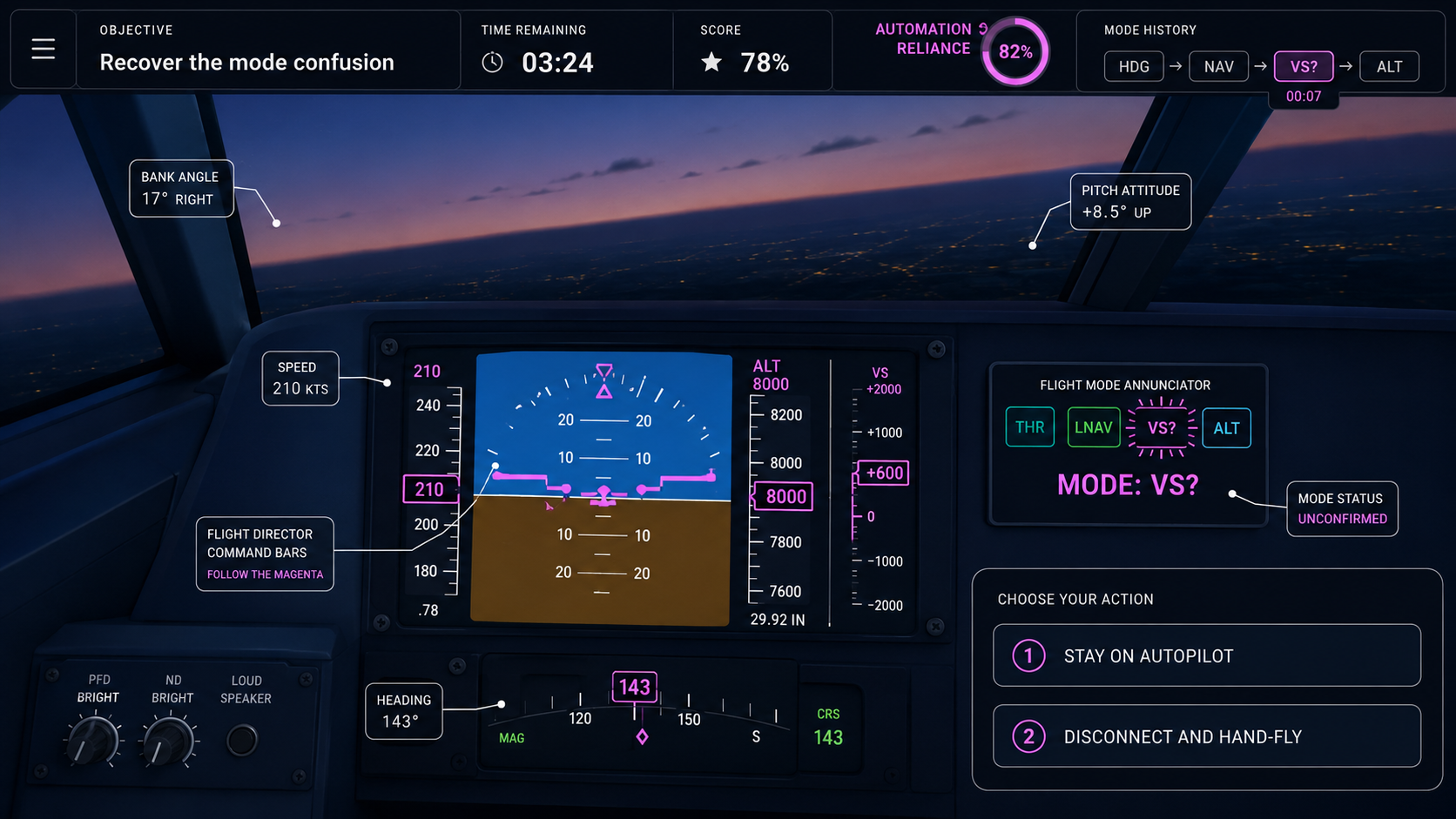
An automation-management game named after the famous training brief on over-reliance on the magenta line. Players manage modes through a normal flight until it stops being normal: a mode reversion, a failure the automation hands back without warning, the startle of an aircraft doing something the crew didn’t ask for. Scoring rewards knowing when to climb the automation ladder and when to click it all off and fly. Built on Asiana 214 and AF447, two accidents about capable crews in capable aircraft that stopped flying the airplane.

Use Case
Flight crews, type-rating and recurrent training, EBT programs
Key Skills
Mode awareness, automation management, manual handling, upset and startle response, monitoring
The Report GU-AV-08 SMS

The Report

Safety Culture Decision Game

Click to expand ↓

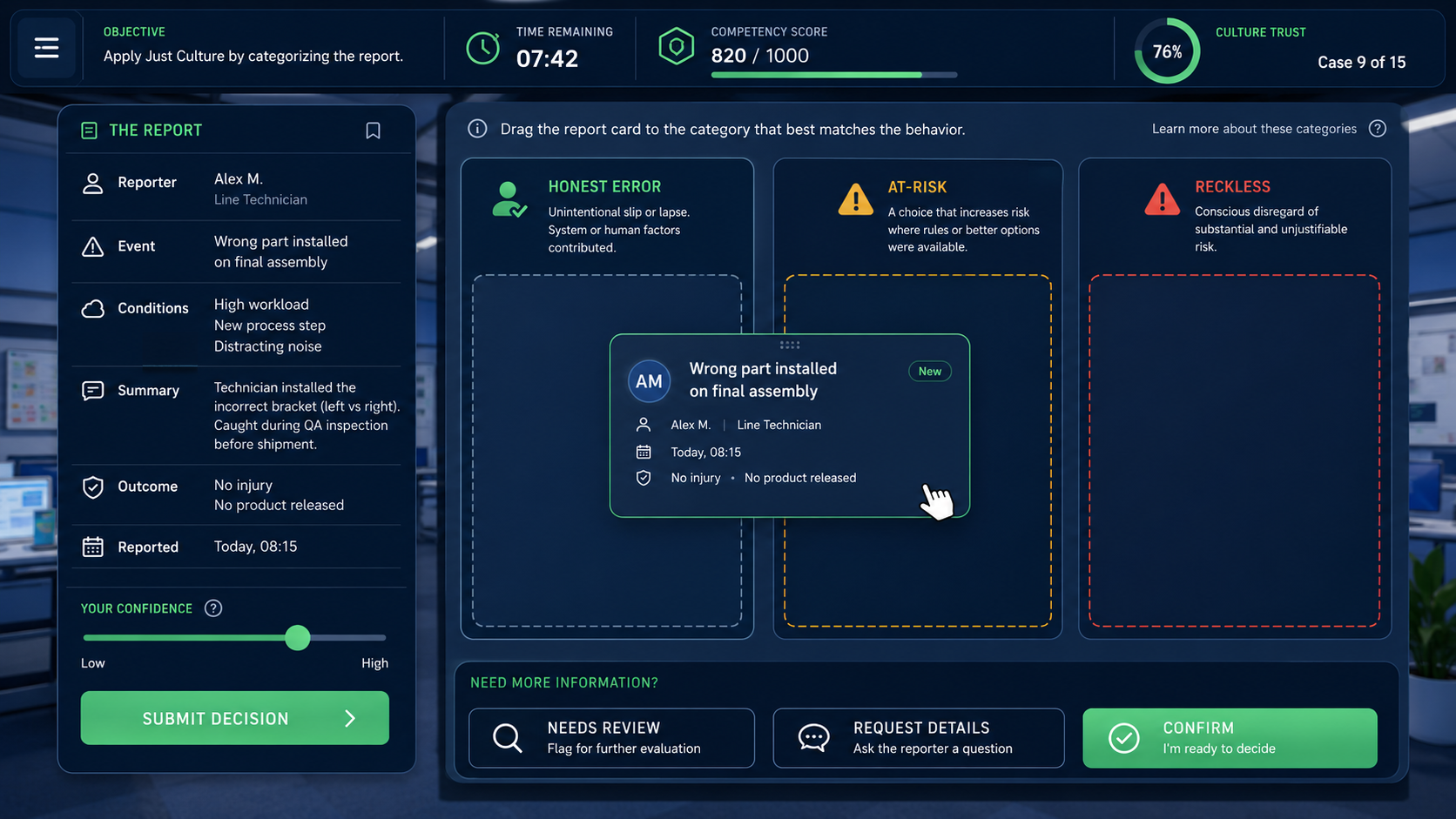
A two-sided SMS game. As frontline crew, the player decides whether to file the report nobody is making them file, weighing the hassle against the hazard. As the safety manager, they triage what comes in through a Just Culture lens: honest error, at-risk behavior, or the rare reckless act that does cross the line. The game makes the trade-off real, because a reporting culture lives or dies on whether the second decision keeps faith with the first. Built around ICAO Annex 19 and the safety management system every operator now runs.

Use Case
Safety and SMS teams, accountable managers, line crew across flight, cabin, ground and maintenance
Key Skills
Hazard reporting, Just Culture judgment, error classification, safety-culture leadership
Level 1 to 4 GU-AV-09 De-escalation

Level 1 to 4

AI Voice & Dialogue Roleplay

Click to expand ↓

An AI voice and dialogue roleplay for the unruly-passenger problem that has spiked since 2021. The player faces an escalating cabin: a passenger refusing to comply, a dispute turning physical, the call on when words stop working and the crew has to act. The AI responds in character as the situation climbs the ICAO disruptive-behavior levels, and scoring covers de-escalation, crew coordination, the decision to restrain, and when to recommend a diversion. The conversation a safety card and a slide deck can never rehearse.

Use Case
Cabin crew, cabin managers, ground and gate staff, security-awareness programs
Key Skills
De-escalation, threat assessment, crew coordination, restraint and diversion decisions
Hot Spot GU-AV-10 Runway Safety

Hot Spot

Ground-Movement Decision Game

Click to expand ↓

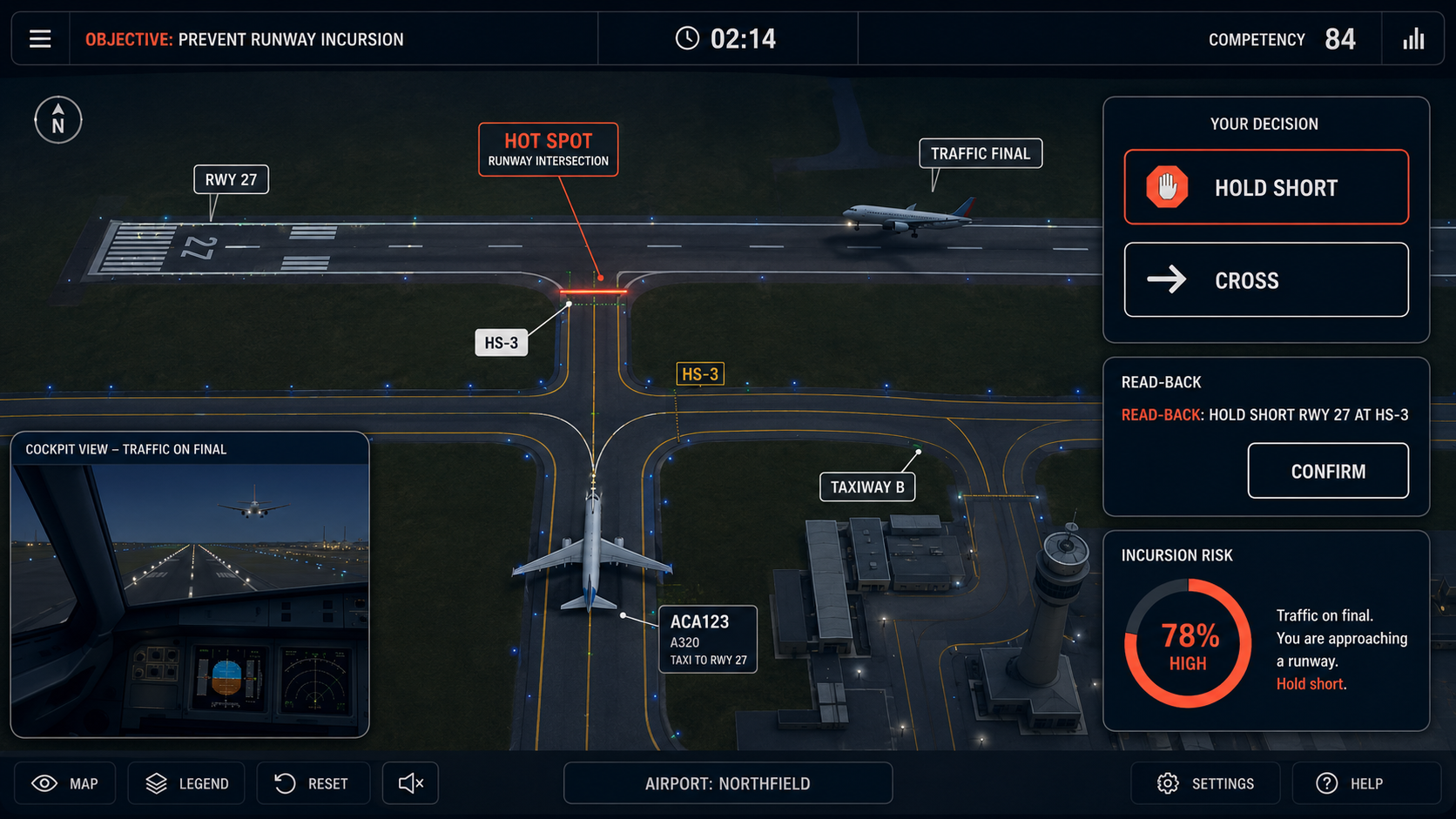
A ground-movement game built around the runway incursion, still one of aviation’s most stubborn risks. Players read clearances, taxi diagrams, and airfield hot spots from the seat of a pilot, a vehicle driver, or the tower, and decide what to confirm, what to question, and when to stop short. A misheard clearance or an assumed line-up is all it takes. Built on Air Canada 759, the 2017 near-miss at San Francisco that came within feet of becoming the worst accident in history.

Use Case
Flight crews, airside vehicle drivers, ATC and ANSP training, airport operations
Key Skills
Clearance read-back discipline, airfield awareness, hold-short decisions, ground communication

Built around the frameworks your operation already answers to.

ICAO CBTA & PANS-TRG

Competency-Based Training and Assessment is the spine of modern aviation training: ICAO Doc 9868, with nine assessed competencies that fold CRM into the standard. We build practice that maps to the competency framework your authority and operator already grade against.

Trained by: The Gradient · Children of the Magenta

Evidence-Based Training

ICAO Doc 9995 and the EASA EBT rules moved recurrent flight-crew training off repetitive set-piece maneuvers and onto competencies drawn from real operational data. Our scenarios are built to feed that model, not fight it.

Trained by: The Gradient · Children of the Magenta

Cabin Safety & SEP

EASA Part-CC and the FAA cabin requirements set the safety and emergency procedures every crew recerts on. We don’t replace the door and slide drills; we sharpen the assessment and command decisions between them.

Trained by: Ninety Seconds · Level 1 to 4

Maintenance Human Factors

EASA Part-145 and Part-66 human-factors training, built on the Dirty Dozen that UK CAA CAP 715 turned into the maintenance HF standard. Trained as decisions under shift pressure, not a list memorized once a year.

Trained by: The Last Inspection

Dangerous Goods (Annex 18 / DGR)

ICAO Annex 18 and the IATA DGR govern how dangerous goods move. The DGR is now competency-based, organized around the job functions a person actually performs, which is exactly how a decision game should train it.

Trained by: The Acceptance Desk

Ground Operations (IGOM / ISAGO)

IATA IGOM, the Airport Handling Manual, and the ISAGO audit set the ground-handling baseline. We map ramp and turnaround scenarios to the procedures your stations are actually audited against.

Trained by: Turnaround · Holdover

Safety Management (Annex 19)

ICAO Annex 19 requires a working safety management system and the Just Culture that feeds it. We build the reporting and triage decisions that keep an SMS from becoming a binder nobody opens.

Trained by: The Report

Regional & Audit: GCAA, GACA, QCAA & IOSA

Gulf operators answer to the UAE GCAA, Saudi GACA, and Qatar QCAA, and most carriers run against the IATA IOSA standard on top of the global frameworks. We map content to the authority and the audit your operation actually holds, not just the ICAO baseline.

Trained by: Mapped to your approved program

Training-credit eligibility varies by authority and operator. We work with your training and safety teams to align simulation content with the frameworks your operation is approved under, and pursue authority or operator-specific acceptance where it adds value. There’s more on our cross-industry approach in safety training simulations.

Whoever owns training and safety at your operation, this works for you.

HEADS OF TRAINING & TRAINING CAPTAINS

Give crews competency practice that maps to your EBT and CBTA program, before the expensive sim slot, not instead of it. Recurrent scenarios they actually replay, with per-competency data you can take into a training review.

DIRECTORS OF SAFETY & ACCOUNTABLE MANAGERS

Train the leading-indicator behaviors your SMS is supposed to move: reporting, speak-up, threat and error management. Tie training to the hazards in your own data, segmented by fleet, base, and crew the way a safety review actually needs.

CABIN & GROUND OPERATIONS LEADERS

Drill the decisions that drive your numbers: evacuation command, disruptive-passenger calls, turnaround judgment, the ground damage that quietly eats the budget. Readiness you can verify, not hope for.

MRO, ACADEMY TRAINING & PROCUREMENT

Onboard Part-66 and Part-147 talent faster with human-factors practice that holds up to an audit. Multi-base, multi-language, multi-authority deployment that integrates with your LMS and doesn’t fall over at rollout.

Every surface. Built for it.

VR, mobile, web and LMS, or the classroom. We build for each platform directly and design for the surfaces your people actually use, whether that’s one of them or several.

SURFACE · 01

VR (Meta Quest)

High-fidelity spatial practice for cabin, ramp, and maintenance scenarios where the body needs to learn the space. Headsets in a kit, ship to the base, run a cohort. Pairs cleanly with classroom debrief.

SURFACE · 02

Mobile (Offline)

iOS and Android, running offline at the gate, the line station, and the crew room. Recurrent reps, refreshers, and microlearning. Progress caches locally and syncs when connectivity returns.

SURFACE · 03

Web & LMS

Browser-based, SCORM and xAPI, SSO-ready. Integrates with your LMS and training records so competency data lands where your training and compliance teams already look.

SURFACE · 04

Classroom & Live

Facilitator packs, multiplayer crew exercises, and after-action replays for CRM days, recurrent, and safety stand-downs. The debrief layer your sim sessions and toolbox talks have been missing.

From brief to build.

Four stages. Typically 8 to 16 weeks from first call to deployed simulation, and we can start with a single-title pilot if that fits your procurement cycle better.

  1. 01

    Discover

    We embed with your training, safety, and ops teams to map the competencies, procedures, and events that matter most to your fleet and your operation.

  2. 02

    Design

    Game designers co-create the scenarios with your instructors and SMEs, and pilot with one fleet or one base before any wider rollout.

  3. 03

    Build

    Custom art, systems, scenarios, and narrative crafted in-studio, for the platforms you need: VR, mobile, web, or classroom. Typical timeline 8 to 16 weeks.

  4. 04

    Deploy & Measure

    LMS and SSO integration, competency data tied to your CBTA framework and leading indicators, and ongoing iteration from live player data.

Training that holds when it counts.

Book a 30-minute demo. We’ll show you real training simulations, talk through your fleet, your authority, and the events that shaped your operation, and sketch what a custom build or pilot looks like for your team. No pressure.

Or email braeden@gosuacademy.com directly.