RETAIL GAMIFIED

The clienteling instincts that build a brand and the compliance that keeps your stores open, taught in games associates actually finish, on the phone already in their pocket. Built around your standards, your SOPs, your floor.

Clienteling Loss Prevention De-escalation POS & Returns Onboarding Brand Standards

Retail training never reaches the floor.

Frontline turnover sits above 60% a year. Most training still lives on a desktop course nobody finishes.

The associate on shift, who actually meets the customer, gets a brand book and a morning huddle. The house codes that define your brand stay in the leadership deck. The compliance modules get clicked through. And the floor pays the price.

So make it a game.

Floor skills are built by doing them, not by watching a video. You don’t memorize your way to a clean greeting or a well-handled return. So we build custom games around the real rituals, regulations, and customers your stores see every day.

Brand Books Brand Reflex
Compliance Modules Mandatory Practice
Onboarding Videos Day-One Confidence

The category already works.

Not our pitch. These are published results and industry data from across retail, from teams already running game-based training.

0% Less Onboarding Time Walmart cut a core onboarding module from eight hours to fifteen minutes with a single immersive game. Source: Strivr / Walmart
0% Mobile Completion Mobile-first microlearning runs 80 to 95% completion, against under 15% for a desktop LMS squeezed between shifts. Source: TechClass
0% Less Shrink Pair store tech with real training and shrink drops about a quarter, turning a loss-prevention line item into a training win. Source: NRF
0% Want Mobile Training Three in four frontline retail staff want training on the phone they already carry. Only 14% get it. Source: InternetRetailing

Simulate the skills that matter.

Two tracks. Every title is built custom around your house codes, your floor layout, and the customers you actually serve.

TRACK · A

Customer-Facing

Games that train the clienteling instincts that define your brand on the floor.

  • 01The greeting ritual & reading the room
  • 02Cross-sell & wardrobe building
  • 03VIC handling, discretion & private appointments
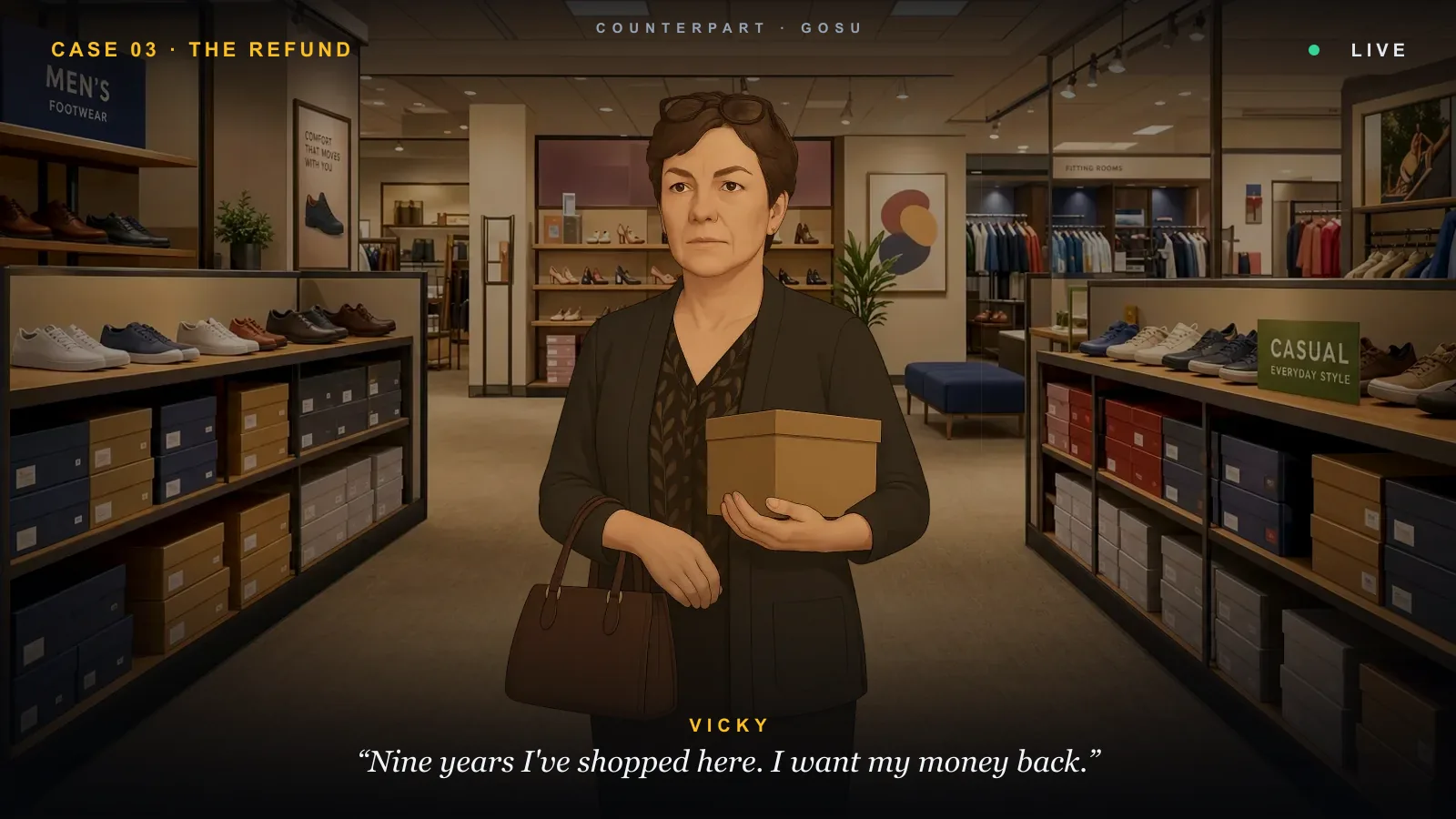
  • 04Difficult conversations: returns, counterfeits, declined cards
  • 05Product story-telling & heritage fluency
TRACK · B

Operational & Compliance

Scenario games that train the SOPs and regulations your stores are on the hook for, every shift.

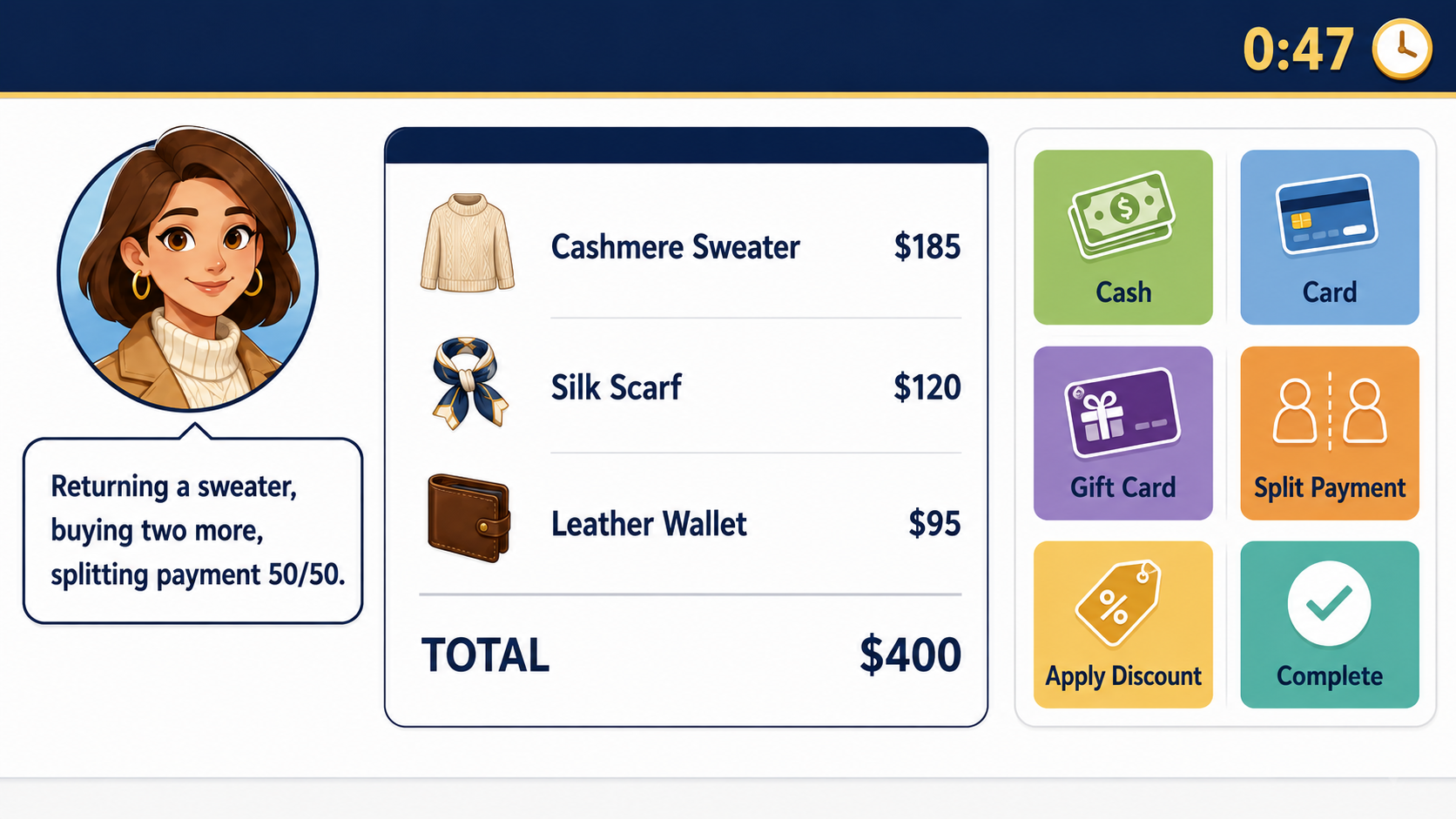
  • 01POS workflows, split payments & returns
  • 02BOPIS handoff & omnichannel ops
  • 03Loss prevention, shrink & ORC detection
  • 04De-escalation & workplace safety
  • 05Payment security (PCI), data privacy & age-restricted sales

Concepts we can build for you.

We build custom training games for retail brands. The six below are concepts we’ve designed to spark ideas. Expand any card to see how it plays, then we build something made for your stores.

The Clienteling Floor GU-RT-01 Clienteling

The Clienteling Floor

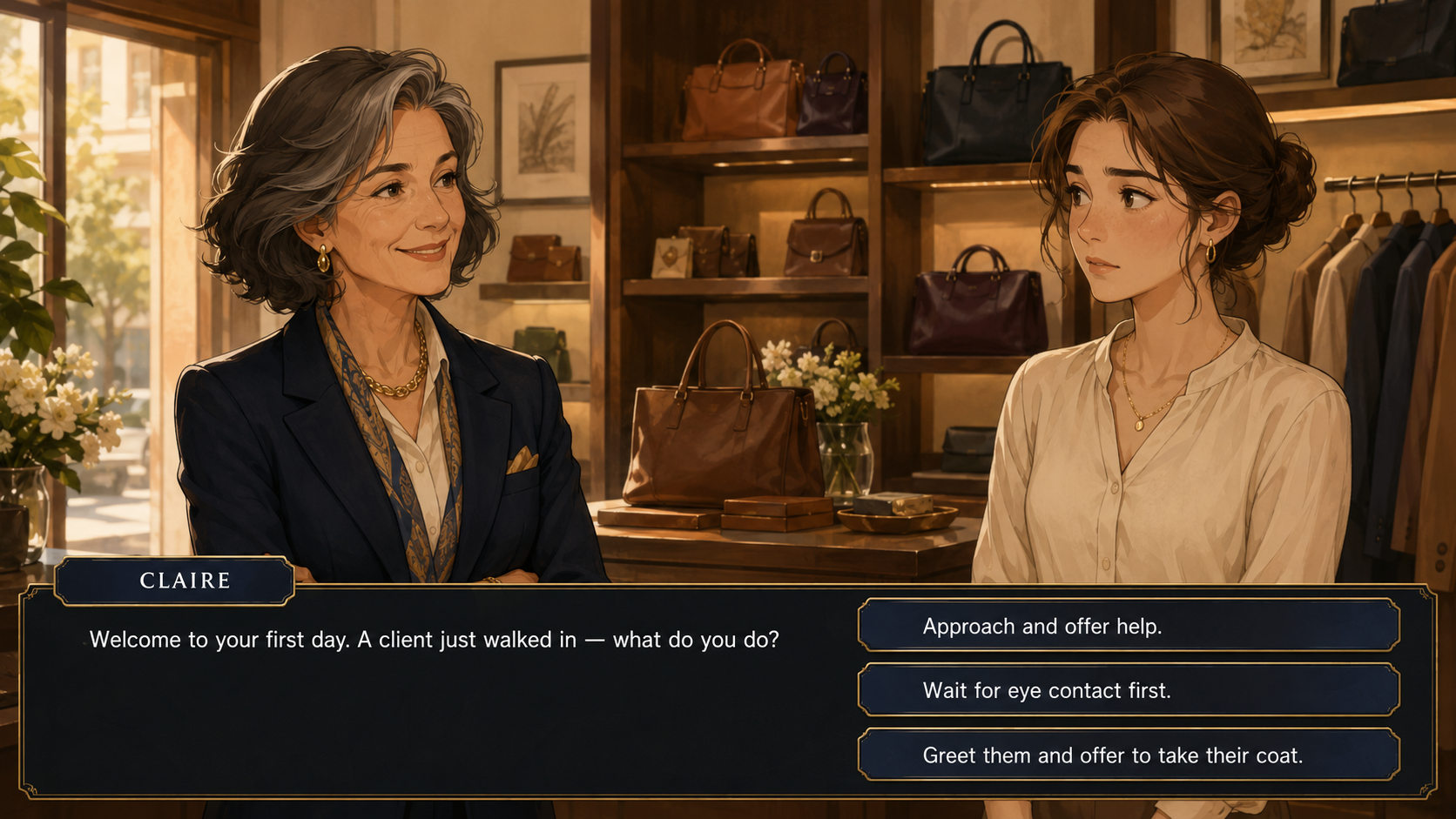
AI Conversational Roleplay

Click to expand ↓

A five-minute AI roleplay where a junior associate practices your brand’s signature greeting, discovery, and close with a Claude-powered customer who reacts to every choice. Players are scored on house-code fidelity, not just outcome. Pulls from your real archive of customer types: the tourist, the VIC, the gift-buyer, the silent browser, the undercover auditor.

Use Case
Boutique sales associates, beauty advisors, specialty retail, new-hire ramp
Key Skills
House-code fluency, discovery questions, cross-sell, reading the silent client
The Maison GU-RT-03 Life Sim

The Maison

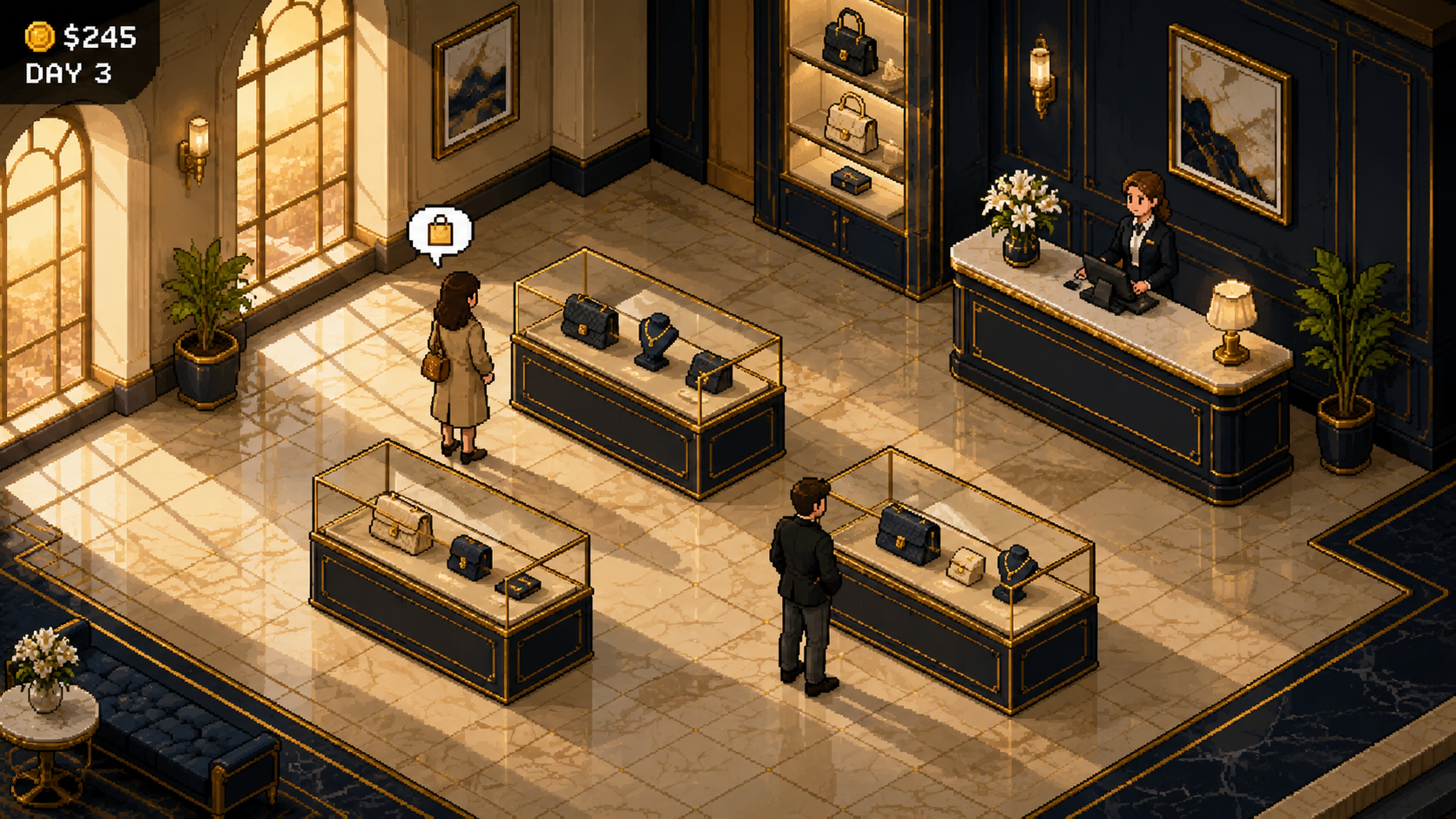
Isometric Career Life Sim

Click to expand ↓

A long-form life sim where the player works from junior associate to Boutique Director across in-game seasons. Each day teaches one SOP. Customers walk in with hidden personality tags the player learns to read. Brand Mastery XP unlocks back-of-house atelier scenes: craft heritage delivered as a reward, never homework.

Use Case
Career-track associates, internal mobility programs, brand academies
Key Skills
Client triage, full sales-cycle pacing, brand heritage fluency, mentoring juniors
First Week GU-RT-04 Onboarding

First Week

Branching Narrative

Click to expand ↓

A five-day branching narrative where the player shadows a senior associate. Each in-game day is a chapter with branching dialogue choices. Wrong choices don’t fail. They trigger a mentor’s gentle correction and a replay. Ends with a graduation moment and a printable certificate.

Use Case
All new hires, mandatory onboarding, seasonal hiring waves, conversion of part-time to full-time
Key Skills
House-code instinct, difficult-conversation framing, peer learning, brand identity
Watch the Floor GU-RT-05 Loss Prevention

Watch the Floor

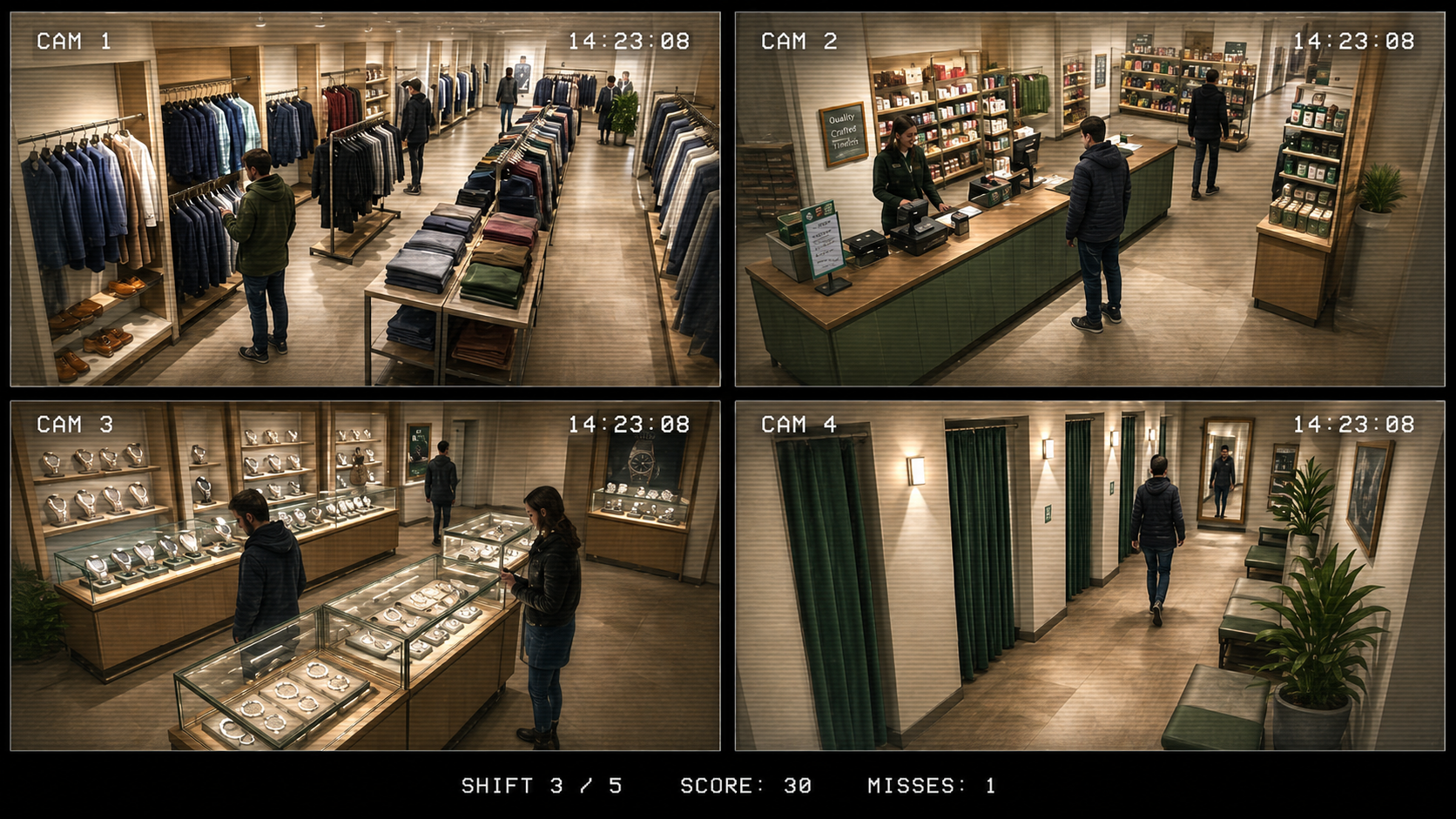
CCTV Vigilance Drill

Click to expand ↓

A thirty-second CCTV vigilance drill. Four security camera feeds play simultaneously; the associate taps the moment they spot a sweep-and-grab, ticket switch, or sleight-of-hand. After each round, a one-line explainer surfaces the pattern. Pairs with measurable shrink-rate outcomes for a six-month ROI story.

Use Case
All sales associates, loss prevention specialists, asset protection teams, store security
Key Skills
Anomaly recognition, behavioral cue reading, ORC pattern awareness, escalation protocols
Atelier Lock-In GU-RT-06 Brand Heritage

Atelier Lock-In

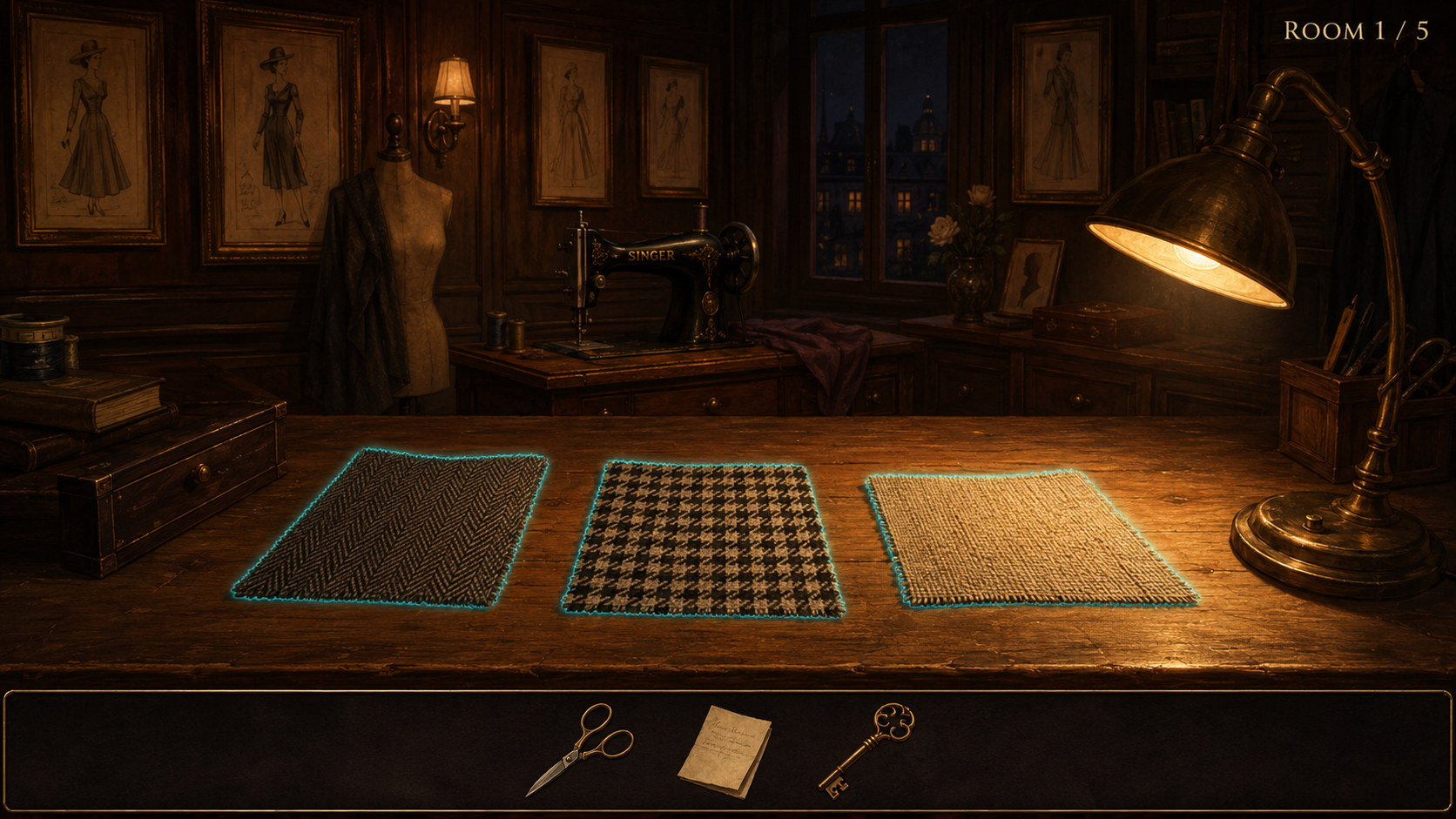
Digital Escape Room

Click to expand ↓

A digital escape room set inside your atelier. The player solves craft puzzles (thread the right cord through the right pattern, identify the right material, decode the founder’s notes), each one teaching brand heritage as a reward, not homework. Re-skins per new collection launch.

Use Case
New collection launches, archive deep-dives, brand academies, beauty consultant heritage training
Key Skills
Craft technique fluency, founder-story command, story-telling on the floor, archive recall
POS Bootcamp GU-RT-07 Operations

POS Bootcamp

Time-Attack Procedural Sim

Click to expand ↓

A sixty-second time-attack of the most common transaction headaches. The associate processes one customer through split payment, loyalty discount, defective return, and a substitution. Speed and accuracy scored. Day-one onboarding compression for hourly retail.

Use Case
Day-one onboarding, seasonal hiring, POS system migrations, returns desk training
Key Skills
POS muscle memory, return policy, split-payment handling, loyalty program execution

Anchor titles for mastery. Daily drills for retention.

Deep skill games and short daily reps, both mobile-first on the device every associate already carries. Together they replace your onboarding LMS and your daily microlearning vendor.

MODE · ANCHOR

Anchor Titles

The flagship game experiences. Twenty to forty minutes of focused play. Used in onboarding cohorts, collection launches, and mandatory compliance training. Each title produces a measurable mastery score the manager sees in their dashboard.

Examples: The Clienteling Floor · First Week · The Maison · Atelier Lock-In

MODE · DAILY

Daily Drills

One- to three-minute mini-games played at the start of shift. Streak-based, habit-forming, and built around brand-specific drills: authenticate the bag, spot the violation, find the VIC in the crowd, beat your POS time. The daily-habit layer most microlearning vendors can’t produce.

Examples: Spot the Real · Watch the Floor · POS Bootcamp

Sixty seconds between customers. Three minutes on a break.

Training that shows up in your numbers.

Every game targets a skill that sits behind a number you already track. Here’s where better-trained associates move the needle.

What the games target

  • UPT & AOV: the clienteling and add-on games drill the upsell conversation that grows basket size.
  • Shrink: the loss-prevention games rehearse the floor habits that keep stock from walking out the door.
  • Time-to-productive: onboarding games cut the ramp from first day to first confident sale.
  • Mystery-shop scores: brand-standard games turn the service script into reflex before the audit.
  • NPS / CSAT: the clienteling games build the rapport customers actually rate.

These are the numbers your operators already answer for. Aim the training at the behavior behind each one, and L&D becomes a business conversation.

Built around the regulations your stores already face.

Workplace Safety & De-escalation

Retail-worker safety is becoming law. New York’s Retail Worker Safety Act took effect June 2, 2025, mandating interactive de-escalation training for retailers with 10+ NY employees, with California, Illinois, and Washington drafting parallel laws and other markets already enforcing violence-at-work duties. We ship those scenarios out of the box.

Covered by: Watch the Floor · The Clienteling Floor

Loss Prevention & Shrink

Shrink is a global drain: US retailers alone lost $121.6B to it in 2024. Most current LP training is posters and morning-meeting reminders. Scenario-based vigilance drills with measurable outcomes against your store-level shrink rate.

Covered by: Watch the Floor

Harassment & Workplace Conduct

Harassment-prevention training is required or expected in most markets, from US states to the Gulf and Europe. Our scenarios fit retail’s actual risk profile: lone closing shifts, customer-on-staff incidents, blurred boundaries in beauty service.

Covered by: First Week · The Clienteling Floor

Payment Security & PCI-DSS

Every retailer handling cards is on the hook for PCI-DSS. Most associate training is a once-a-year click-through. Procedural simulation with realistic split-payment, refund-fraud, and card-handling scenarios.

Covered by: POS Bootcamp

Brand Standards & Service Quality

Not a regulation, but the standard most likely to be violated under shift pressure: greeting cadence, packaging ritual, gift presentation, archive sourcing, VIC discretion. We build the standards directly into clienteling and life-sim games where they become reflex, not recitation.

Covered by: The Clienteling Floor · Atelier Lock-In · The Maison · First Week

Mandatory-training eligibility varies by jurisdiction. We work with your compliance team to align game content with local regulatory requirements and pursue accreditation where it adds value.

Whoever owns training in your stores, this works for you.

L&D & TRAINING DIRECTORS

Swap your worst compliance modules for games associates replay on their own. See who is actually getting better, down to the associate and the skill, instead of a wall of completion ticks.

80-95% mobile completion vs <15% desktop.

STORE OPS & DISTRICT MANAGERS

Cut new-hire ramp from weeks to days, and give managers a coaching dashboard that surfaces who needs a ten-minute huddle this week.

8 hr → 15 min, Walmart Pickup Tower.

LOSS PREVENTION & ASSET PROTECTION

Trade shrink posters and morning reminders for vigilance drills your team actually runs, tracked against store-level shrink over a six-month read.

~25% less shrink with tech plus training.

BRAND & VISUAL STANDARDS

Make the brand book a game associates play, not a deck they skim, and lock in house-code consistency across every store and shift.

New playable per collection in about two weeks.

What the research says.

The floor results hold up in the lab. One peer-reviewed meta-analysis of 65 workplace studies found employees trained in simulation games came out ahead on every measure it tested.

+0%

more confident on the job (self-efficacy), the nerve a new hire needs to act on what they were taught

Sitzmann, Personnel Psychology →
+0%

better at performing the task itself (procedural knowledge), the gap between knowing the policy and running the return

Sitzmann, Personnel Psychology →
+0%

stronger recall of the product and policy facts that walk out the door with every quit (declarative knowledge)

Sitzmann, Personnel Psychology →
+0%

better retention of the skill weeks later, when a slide deck has long since worn off

Sitzmann, Personnel Psychology →

From brief to build.

Four stages. Typically 8 to 16 weeks from first call to deployed game.

  1. 01

    Discover

    We embed with your floor team, walk the floor, sit with customers. The brief comes from the shift, not the deck.

  2. 02

    Design

    Our game designers and your brand leads co-create mechanics that teach the right behaviors. We pilot with a small group of associates.

  3. 03

    Build

    Custom art, systems, narrative, and brand skin crafted in-studio. Typical timeline 8 to 16 weeks.

  4. 04

    Deploy & Measure

    LMS/SSO integration, KPI dashboard, manager-coaching layer, and ongoing iteration from live player and store-KPI data.

Training that sticks.

Book a 30-minute demo. We’ll show you real games built for retail, walk through your stores’ specific challenges, and sketch what a custom build looks like for your brand. Many teams start with a single pilot store. No pressure.